
 |
 |
 |


ADDITIONAL NOTES ON PETER STEELE'S TONE
(written Jan 2020; latest update May 2022)
This page may contain contradictions as I phased things in and out, but I left them here to show what was tried. Expanding on my own effect pedal setup here, the current page includes old setups and goes into detail on certain aspects of my experiments. A lot of this material was from when I thought Peter was blending an always-on clean signal and a distorted signal.
SIMPLIFIED TWO CHAIN (2021)
This was a slightly simplified setup I began using in early 2021, but was rather short-lived...


The above setup actually expanded again in the second half of 2021. I used a Boss LS-2 as my signal switcher (no longer was the clean always heard) and added a second MXR M108. So, each chain had a dedicated EQ, both of which ran into the A and B of the Summer. From the Summer, the signal entered the Polara, then then Sonic Stomp, and into the effects return. During that time, I had removed the Orange Fur Coat. Both of the 2021 setups used an ISP Decimator G-string to quiet the slight hiss of the MT-2 during clean playing.
I quit using a split signal in April 2022 as the chain had gotten out of hand again. The tremolo never really sounded right to me. So once I decided to drop the TR-1, I figured there wasn't any point in maintaining two separate paths. I may have been chasing a wild goose the previous two years, having convinced myself that there were two channels.
MY ORIGINAL TWO-CHAIN METHOD (2020)
Clean Chain: Peter’s sound was likely achieved with two chains, which he reportedly combined using a Marshall ABY box in the earlier years. According to a 1998 interview with him in Bass Player Magazine, “when he wants a clean sound, a Marshall Y-box re-routes the signal through Boss tremolo and reverb pedals.” I have noticed that whenever tremolo is referenced in Pete’s setup, tremolo is mentioned before reverb. Peter preferred Boss pedals due to the brand's ruggedness, so the highly-regarded TR-2 and any RV model are likely candidates. However, the TR-2 did not become available until 1997 and there isn't noticeable tremolo on Black No 1, so I'm doubting a tremolo was in his earlier configurations. A member on TalkBass, that was close to Peter, stated that a flanger easily mimics his clean tone. The BF-2 adds an airy creepiness, so I run both with the BF-2 always on and in front of a TR-2 that I might use occasinally. The reverb provides depth and even masks sloppiness when following these pedals.
My clean chain begins at the bypass jack of my Boss TU-3, into the front of the Gallien-Krueger 800RB, out from the effects send, into a Boss BF-2, then a TR-2, followed by a DigiTech Polara (set for Spring Reverb), and into a Saturnworks Passive Summer. The 800RB's preamp provides additional headroom for the clean channel’s output to achieve volume unity with the distortion signal.
The flanger definitely adds something to the clean tone that sounds very Type O Negative. Because of that, I thought it odd that it wasn't mentioned in his clean chain during that Bass Player Magazine interview. So I tried sharing a flanger just before the signal split at the TU-3, but didn't like the muddiness of the distortion side. I then tried adding a second one after the MT-2 (the first one still in the clean chain), where it sounded very good, but it did not sound like Peter Steele. Trying every option, I moved the one BF-2 from the beginning of the clean chain to right after the summer: cool, but it's too much of the effect in the distortion chain.
Core of the Distortion Chain: The DS-1 will fall short trying to mimic Pete’s sound, likely because it was only part of the distortion equation (March 2024: likely because Josh was playing distorted keyboards to help make Peter's impressive live sound). I found using my 800RB’s preamp colored my distortion tone negatively, plus it doesn’t produce any dirt on its own. After trying a dozen pedals in different configurations and combinations, I ultimately settled on a Boss MT-2* as the basis of my distortion. The MT-2 has a very tweakable EQ to fine tune the tone via the pedal’s mid controls and the circuit provides a substantial amount of compression, which are reasons I feel it works well here.
* I went back and forth between the DS-1 and the MT-2 several times. There are tonal nuances of the DS-1 that I like, plus the sheer simplicity of it. The core of the DS-1 sounds more Peter Steele-esque, of course. However, the MT-2 produces additional gain and compression that easily edges out the DS-1 by providing a smoother drive and tighter palm mutes. A cranked DS-1 following the compressor's boost also suffers from a lot of noise that requires an aggressive noise gate. If you want to go crazy, add a DS-1 right after the MT-2 for instant feedback ...plus, have the option of two distinct distortion tones.
I even considered that maybe Peter modified his DS-1, so I did some tinkering with mine. Although I got it a little closer to his tone, it still didn't produce the oomph that the MT-2 does. Plus, the modded pedal actually seems to suffer when pushed to maximum gain. Read below for results of the DS-1 mods that I tried and recommend.
Again, both signals running simultaneously lets the clean signal help define the lower end of the distortion. In the photo of Pete’s pedal chain, note that the distortion signal passes out through the output jack of his TU-2, rather than the bypass jack. The bypass jack allows the signal to be heard even while tuning, whereas the output jack is muted during tuning. In theory, this could have allowed Peter to engage the tuner to mute his entire distortion chain, therefore making it his channel switcher.
More of the Distortion Chain: A Boss CH-1 seems to help Peter gets his self-described "wall of diarrhea" sound from his distortion, adding a bit of warble to the signal. There is confusion surrounding the DD-3, especially since the pedal board photo implies two different settings. I do recall a quote from Peter saying that reverb is great for hiding mistakes, so I wasn’t sure if this was done in addition to the clean signal with an always-on DD-3. Then I stumbled on a forum post claiming that "for certain, the chorus was always on with distortion...the delay was occasional." Noting his pedalboard pic, you will see the D-LAY label is directing the knob to be set in Hold mode for infinite sustain and/or repeat. I eventually decided the delay pedal could be omitted as it provided no apparent benefit. I added a Boss NS-2 that essentially silences this chain when running the clean signal on it’s own.
Early on, I thought that the EQ setting on Peter’s CH-1 to be too trebly, so I backed that all the way off for months (granted, we now know that the reference setting was for Carnivore). But I eventually found that the extra treble from the CH-1 and the MT-2 added more chunk to palm mutes, smoothed out pick scrapes, and made everything sound bigger.
Equalization: I read a post written by Peter’s 1990-era tech that graphic equalization was essential to sculpting his distortion tone.* For about a year, I ran a single MXR M108S to adjust the frequencies of the combined signal. Then I decided to try it at the end of the distortion chain, only. It may be me, but I think it does a better job handling the lone distortion signal and allows for a "warmer" blend of the clean signal. I definitely noticed that my cleans got cleaner since the equalizer wasn't amplifying the pedal noise in that chain. With the graphic equalizer now at the end of the distortion chain, I relied on the 800RB's preamp knobs to fine tune the clean tone. I had also tried an additional EQ at the beginning of the distortion chain, right after the TU-3, but it wasn't significant enough to warrant another pedal.
My distortion chain starts at a Boss NS-2 that contains the Boss MT-2, Boss CH-1, and MXR M108S inside its loop, then out to the A/B-side of my Saturnworks Passive Summer.
* Precise cuts and boosts of the equalizer are critical to a smooth distortion tone and percussive palm mutes. While taking photos of the pedal chains for this page, I had inadvertently bumped a few sliders. When I set everything back up, I readjusted the entire EQ curve from memory - the result was very harsh with what I would describe as a honky mid-range. Luckily, I had an older photo of my original settings, which were subtly lower across all ten frequencies. My EQ settings provide smooth distortion on all three of my very different 4-strings with the instrument's active controls all at the neutral detent, or passive tone knobs set to 10.
Combining Signals: That same 1990-era tech recommended following everything in the distortion chain (including any equalizers) with a BBE Sonic Maximizer to help clean up the bottom end, just before it hits the power amp. Though some consider these exciter or enhancer effects snake oil, I found a YouTuber successfully employing one for this same purpose. I bought a used BBE Sonic Stomp and it definitely helps define the bass and punch everything up better, even with an equalizer placed right before it. With the clean and distorted chains plugged into the A/B-jacks of a Saturnworks Passive Summer and exiting out the Y-jack, I ran this combined signal into the Sonic Stomp and then into my G-K 800RB's effects return.
Exciter effects: These things do work for certain situations. They might not be everyone's cup of tea and are categorized as quackery by some, but I can tell you that they can make a difference. Exciters, or aural enhancers, are essentially dynamic equalizers that make adjustments to trick our ears into hearing more definition, and they can do this in different ways. For example, BBE exciters slightly delay mids and lows while making phase adjustments. Aphex exciters also use phase shifts, but apply additional harmonics for clearer highs and sometimes clearer lows. If you're familiar with a presence knob on an amplifier, it may help to think of exciters as a version of a presence controller.
Exciters seem to have lost popularity, possibly due to amplifier manufactures producing cleaner circuits, so adding an exciter can sometimes make things sound overly harsh. Where I found the BBE useful is at the end of my effects-laden distortion chain to tighten it all up. I eventually bought a TCHelicon T1 for vocals because I wanted to try a de-ess pedal, but their info page is extremely vague beyond the knob labels - it has a "warmth" button? Initially, I couldn't figure out what it was doing, but it may be some form of aural enhancer circuitry ...vagueness is typical with exciter effects.
Compression: There are witnesses stating the use of extensive compression (especially post), but I’ve not been able to locate anything specific on that except that he reportedly used both pre and post. I found the only substantial compression benefit came from placing it straight out of the instrument. This may be because the MT-2 is already doing plenty of "post" compression on its own? Not only did the compressor alleviate picking discrepancies in my clean signal, it also prolonged my sustain and further smoothed-out the gain in the distortion chain. Previously, I was using a Boss SD-1W to drive my MT-2 for sustain, totally oblivious to the power of "properly adjusted" compression. With the compressor boosting the signal, it allowed me to remove the overdrive from the chain.
I already had a Markbass Compressore lying around and decided to set it on the extremely aggressive side. I'm very far from a compression expert, but it is dead-quiet and it doesn't distort no matter how high the Compressore's gain is set. With the pedal affecting both chains, noise-free is an important characteristic. My initial hang-up with it was that it didn't have a blend knob, but being so transparent, I don't feel it needs one. Place the compresssor pedal after the instrument, then leave it always on like every other pedal.
Eventually, I eliminated the compression because I didn't like how it affected my distorted palm mutes. I do like how it can make my clean signal sound a tiny bit fuller and more consistent, so I tried placing it only in the clean chain. The compression helps boost clean notes that aren't perfectly fretted and clean slides, but the overall difference is quite minimal. So, I coudn't justify adding another pedal.
TL;DR
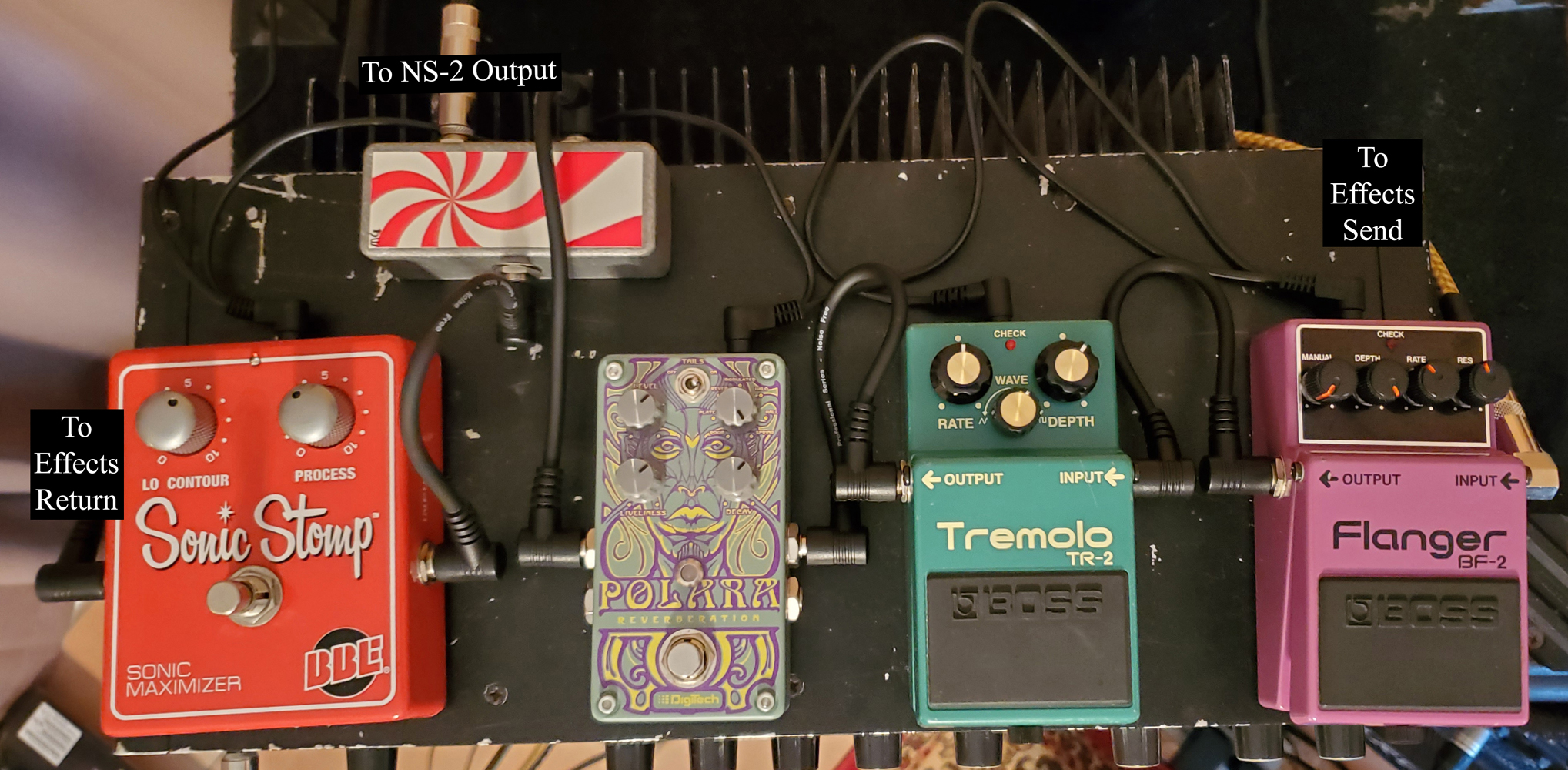
Clean Chain & Summer
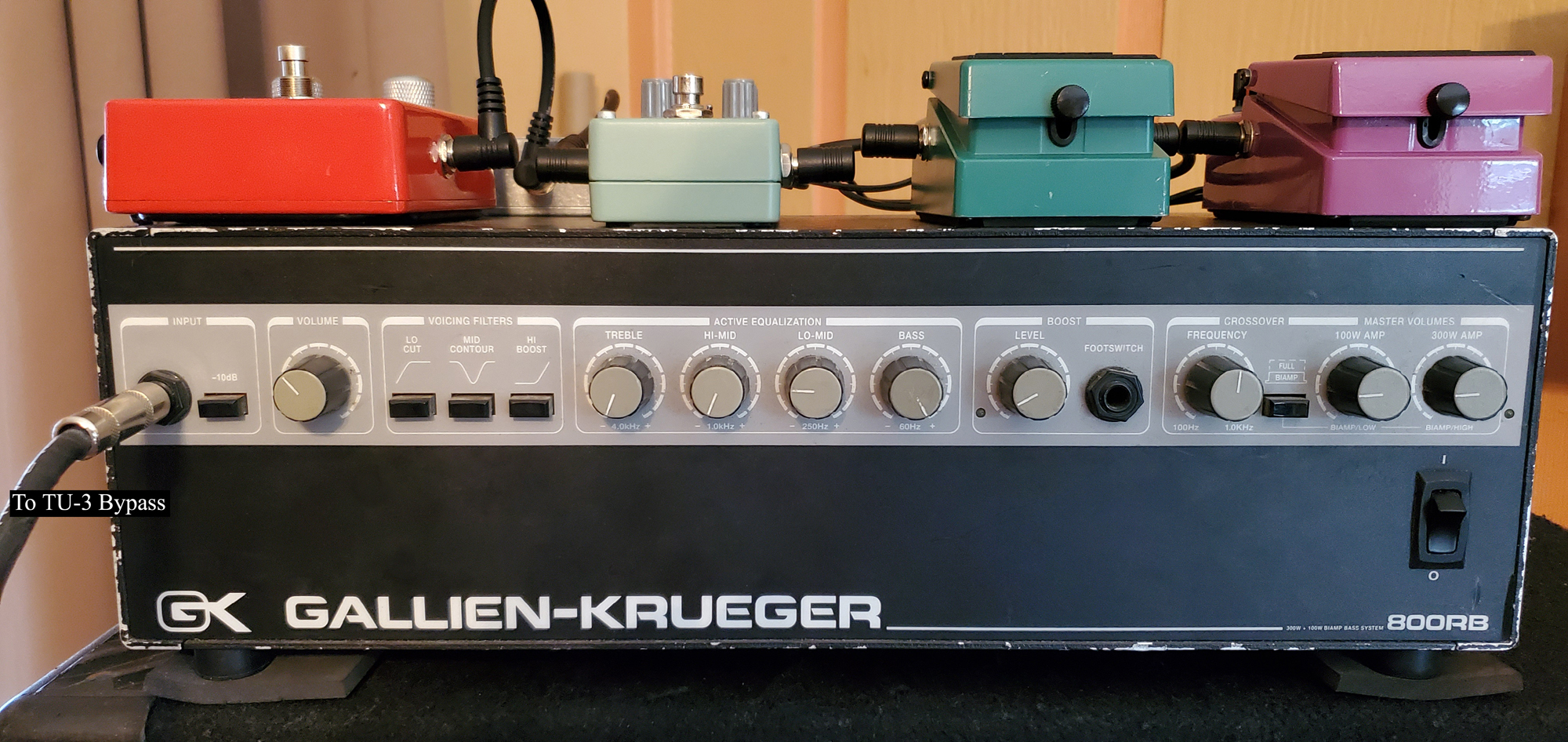
Amplifier
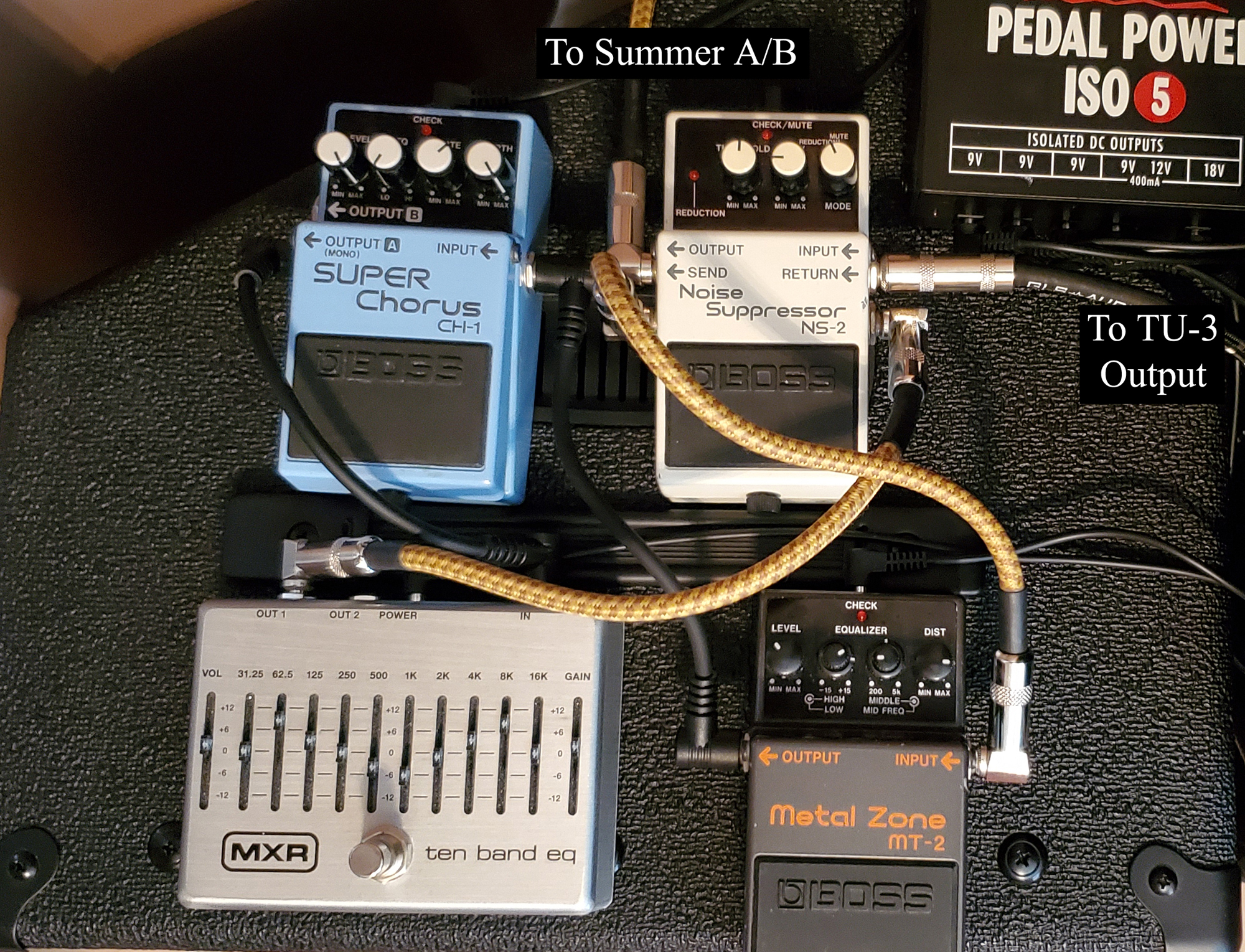
Distortion Chain
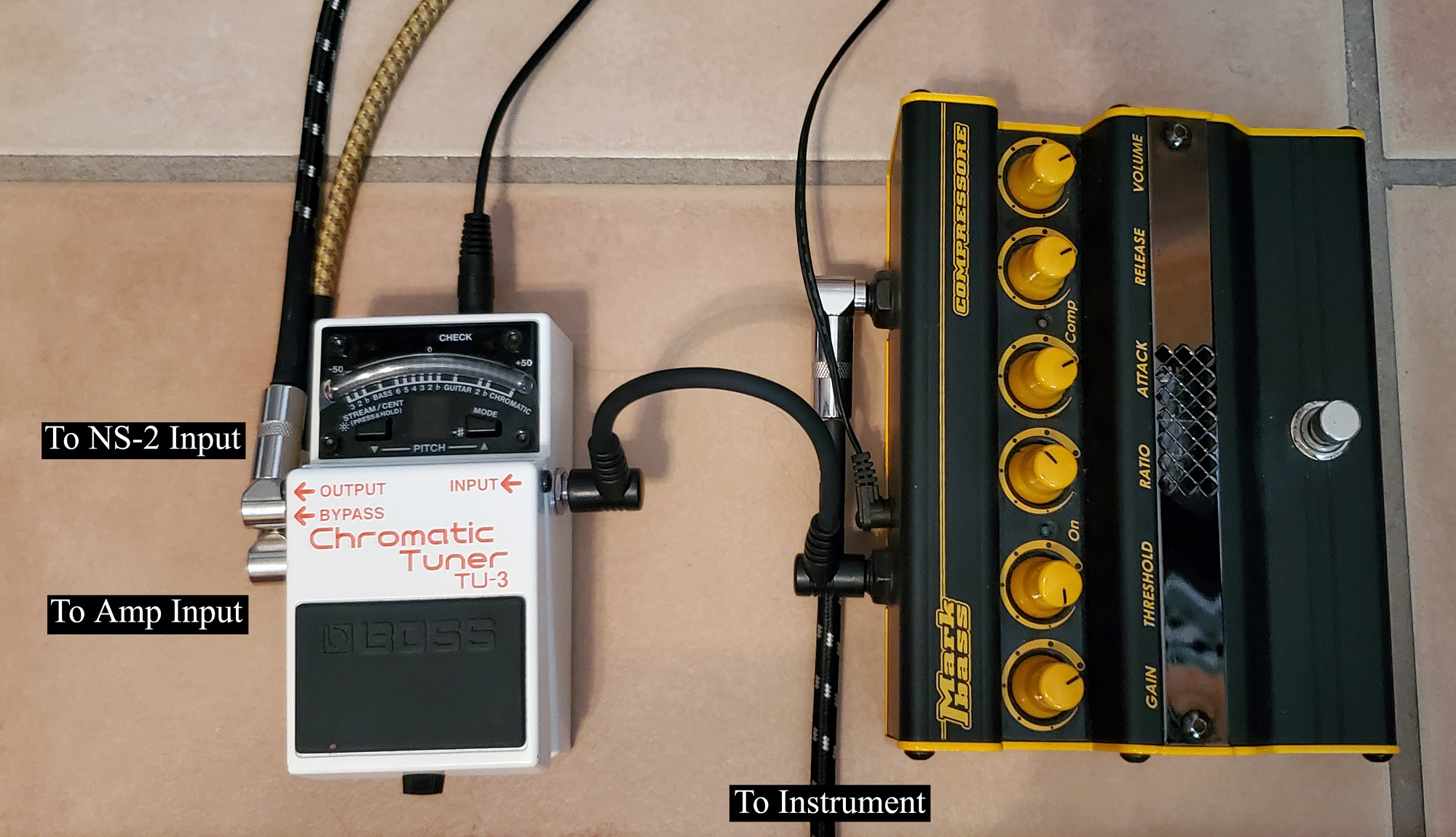
Compression and Splitter
STEELE TONE ON THE CHEAP
According to a personal friend of Peter’s in a TalkBass post, his clean signal can be closely mimicked utilizing only a Boss BF-2 Flanger, so I bought one to minimize the number of pedals when I got started. Playing around, I did notice that not only does the CH-1 slightly fatten up the tone ("wall of diarrhea"), but it gives the sustain that signature Type O Negative warble. As for the delay, I explain below why I currently do not run one in either chain.
With the tweakable EQ and the circuit providing compression, the Boss MT-2 is a very simple solution to a complex problem. So, getting started with minimal cash, you could just run an MT-2 and a CH-1* inline between the instrument and the amp (see next section). A decent setup would be a TU-3, MT-2, CH-1 , and a BBE Sonic Stomp.
* or a flanger, if you already have one.
BOSS METAL ZONE vs DIGITECH METAL MASTER vs DIGITECH DEATH METAL
Looking for information to mimic Peter's distortion tone, I ran across a talented bassist on YouTube going by thegreenbandits, TheGreen Bandits, and Circle Minus (most current). He states he eventually began using a DigiTech Metal Master (he also mentions the DigiTech Death Metal) over the DS-1, especially for earlier-era covers, which connects to a CH-1. He combines this signal and the direct output jack (cabinet emulator) of the Metal Master at a mixer or computer. That's his pedal chain. The only other thing he says he uses is an equalizer, which may be in his software. The out-of-production Metal Master was a rival of the infamous Boss MT-2 Metal Zone, marketed to hair metal guitarists. I had read a few posts mentioning the MT-2 for this job, but had naively written them off. When my Metal Master arrived in the mail, I couldn’t believe it. For a cheap, two-pedal distortion chain that gets in the ballpark, you could use either one of these with any chorus that you have lying around.
* The Green Bandit originally used a stock Boss DS-1 for later-era covers, but began to use the Metal Master to achieve a more accurate tone for Bloody Kisses covers. He mentions that either pedal has to be tweaked, along with an equalizer, for each album that he covers ...and this can sometimes take him a while. So, there appears to be no silver bullet set up.
The MT-2 can be adjusted to have a smoother drive, but the Metal Master sounds monstrous with minimal fiddling since it has no gain knob - the circuit is locked to eleven. Initially, I preferred the Metal Master's simplicity, but the Boss has knobs for the middle frequency range that the DigiTech doesn't. A/B-ing them, I can get the MT-2 to sound like the Metal Master, but I can't get the Metal Master to sound like all the tones that the MT-2 can produce. Although I love the Metal Master so much that I bought a spare, the Boss wins by a hair because the Digi's tones are also inside it. The MT-2 has a bad reputation that seems to be attributed to a lack of understanding. Run it as the preamp and spend some time messing with the mid controls to unlock a plethora of tones. The Death Metal is like if you threw an overdrive before either of these pedals and will get you some feedback.
DIFFERENT VERSIONS OF THE BOSS DS-1
There's talk that the pedals before 1994 used a smoother, warmer op amp: the Toshiba TA3176 (extremely rare), then the TA3176P, and finally the TA3176AP. This had me wondering if that was my problem, as my oldest DS-1 was a 2016 DS-1-4A and Peter was likely buying his DS-1 pedals around 1990. By 1994, the single op amp Toshiba op amp was out of print, so Boss changed the circuit to use the newer dual op amps. I bought a few DS-1 pedals and verified the op amps. My 1987 DS-1 had the Toshiba chip in it, my 1999 DS-1A used the Rohm's BA728N, and the 2016 DS-1-4A had JRC's NJM3404AL. Comparing my three DS-1 pedals with the necessary brutal settings, I could not discern any substantial difference between t he circuits. The differences might be noticeable with more-subtle levels of distortion, but they could not be found when maxed out. Waste of money and time - don't let it waste yours, too.
If you want to try a Boss DS-1, just buy the cheapest one you can find.
WHAT ABOUT MODDING THE BOSS DS-1?
The DS-1 just won't quite give you that seething October Rust distortion. Despite calling himself a simpleton, I started to wonder if maybe Peter was considered a tinkerer, not only for adding tweeters to his cabs, but for modifying his DS-1. After doing some research to determine what mods may have been around at that time, I decided a diode change, reduced bass filtering, and maybe additional gain were plausible. I opted to try the Monte Allums Rectifier Tri-Gain Mod with the dual op-amp upgrade to try out several possibilities. I modded a 40th Anniversary Edition (DS-1-4A; PCB; PSA power), which is based on the pre-SMT* Taiwan circuit (DS-1A; PCB; PSA power). This circuit differs slightly from the original Japan circuit (DS-1; PCB; ACA power) that Boss seems to imply it to be replicating. The vintage MIJ model uses an integrated chip (IC; aka op-amp) with seven legs, while the MIT format uses an IC with eight legs.
* SMT = Surface Mount Technology (difficult to modify) . . . PCB = Printed Circuit Board (easy to modify)
The Monte Allums mod mainly focuses on improving the lower mids, reducing the icepick tone it is infamous for, and improving clarity. The "Tri-Gain" circuit adds a three-way switch: one side passes the signal through two LEDs, the other through two new diodes (aka Rectifier Mod), and the middle which is very similar to the LED side to me. I much prefer the diode/Recifier side, so to do it over, I'd eliminate the Tri-Gain option and the hassle it entails. The mod instructions say the new diodes and LEDs are wired parallel, but I think they are illustrated as antiparallel (though I'm quite naive with circuitry). Maybe Peter replaced the original diodes with a pair of 1N4002 diodes, in some configuration whether it was series, parallel, or antiparallel. These diodes increase gain and sustain, while also producing smoother distortion.
I also tried two additional modifications that may have been around in Peter's era.* One was to remove R16 and replace it with a jumper wire. In my opinion, this produced the most dramatic positive change by allowing more bass to clearly filter through. My B-string rings clearer with this mod, even slightly better than the MT-2. The other was to replace the 4.7k ohm resistor at R13 with a 1k ohm resistor to get more gain. Replacing it with a 1k ohm resistor does increase gain (in a good way), but it also produces a constant flabby noise at higher gain levels that my NS-2 could not easily clamp down, rendering it unusable. It also seemingly caused the gain to only function in the last quarter of the rotation - the gain became dramatically milder and less noisy at about 2o'clock, but didn't change much within the remainder of the potentiometer's sweep counterclockwise. R13 went back to stock.
* As this endeavor has grown, I began thinking that it is likely overblown that Peter was a tinkerer. I believe he liked to keep things simple, especially in the later years. I know there are stories of him loading his early cabinets with tweeters, but there is literally nothing beyond that.
With the modifications complete and R13 returned to stock, I found a shortcoming with the modded pedal. The upgrades produce more gain, which has a pro and a con. Aside from the obvious pro, the con is that it suffers a flabbiness issue somewhat similar to that of the R13 resistor swap when the gain is turned beyond 3o'clock. The difference is that I can only hear it immediately following mutes, rather than it being constant like the R13 mod. For example, once the meaty chunk of a palm mute ends, it briefly trails off with a very undesirable, flabby echo - brutal tightness is totally lost. Although less subtle, it has the same issue with my guitar rig. I even tried reverting R16 back to stock, but this didn't help. If you try to mod the DS-1, I'd first suggest replacing R16 with a jumper only. Then experiment with diode upgrades in D4 and D5. It's more Peter-esque than a stock DS-1, but it still falls short and can be quite noisy at high gain if being fed with a compressed signal (which will require a noise gate).
DISTORTION CHAIN ALTERNATIVES
Before trying aggressive pre-compression, I found that various two-pedal combos got me fairly good results, so try stacking whatever overdrive and dirt pedals you have on-hand. I personally had initial success with an Ibanez TubeScreamer or Boss SD-1 driving a Boss DS-1. Set the DS-1 to Peter's settings, then back off the volume for unity. I also liked an Electro-Harmonix Bass Big Muff Pi. The Muff's fuzz circuitry provides more natural-sounding sustain, although it can be boomy and the break-up doesn't help us trying to smooth out the distortion. An Orange Fur Coat into a CH-1 works better.

FUZZ?
Maybe I don't fully understand fuzz, and that could be why I have a strange relationship with it. I really love the rich, hairy distortion that fuzz can produce, but I personally dislike the circuit's inability to be predictable, or rather, how some fuzzes don't play nice with certain pedals and instruments. Apparently, this has to do with headroom and clipping characteristics, which can make some cool pedals especially finicky. My least favorite recommendation from a manual: for the best sound, place the fuzz after the guitar, but before the amp. So no other pedals? Exactly. Well, that can be a problem if using a split signal. This is because some buffers and active instruments can negatively alter the fuzz.
The first fuzz that I tried was a DOD Carcosa after reading a Reddit where someone claimed to have accidentally gotten a Peter Steel tone with it. This pedal didn't work for me at all, as it seemed too aggressive (though I might not have been following the above recommendation) and the control labels were confusing. The next was an EHX Bass Muff Pi, which doesn't seem to be bothered by the rest of the chain as dramatically as other fuzzes, though it was a bit boomy and felt weak against the MT-2. At that point, I had given up on fuzz. But when I started learning to sing/play Christian Woman, I felt that a fuzz might be worth looking into again...
Enter the Orange Fur Coat with the fuzz knob cranked. Whoa, what an incredibly badass fuzz tone! When I personally think of fuzz, this is exactly what I want from it. It works well with my CH-1, M108S, and Sonic Stomp. Great tone, seething sustain, with well-defined lows. This pedal has such good low end definition, that it doesn't really need the second chain. Unfortunately, it does annoyingly clip a little (the MT-2 doesn't) and did not play nice with the Markbass Compressore. Still, if you're interested in finding a uniquely-amazing fuzz, this is one to try. I also tried the guitar version of the Deluxe Big Muff Pi hoping the Attack knob would help control the clipping somehow, but it didn't seem drastically different from the Bass Muff ...but I'm also a fuzz noob.
During a short while when I first simplified the chains, I was running an Orange Fur Coat before the Boss MT-2 as a little nudge to put some hair on the tone. The Boss MT-2 is the best single tool for the job here and will do just fine on its own, which is what I ended up doing in the long run. But, if you want to try a fuzz, place it before the MT-2. Engaging both pedals in tandem gave me a slightly looser, funner sound that boosts the sustain with only a little bit of extra hissing noise. I definitely do not feel the Orange Fur Coat to be a better choice for this goal over the Boss MT-2. However, the Fur Coat into a Boss CH-1 sounds amazing into the front input of the amp and has good low end definition.
One fuzz that I'm curious might also work well for this setup is the Massive FX GOAF, although some demos sound like the circuit might be too agressive. But at $300, and produced in limited quanities, I may never bother to find out since I've got the Fur Coat already doing what I like just fine.
COMPRESSION vs OVERDRIVE
I tried my Markbass Compressore with a very aggressive setting at the beginning of the entire rig. A clean, quality compressor provided what the overdrive did, but also added some very desirable characteristics to the whole setup. Not only did it boost my signal like an overdrive, but the Compressore made my playing sound more consistent through both chains and refined my distortion. If you don't have a clean compression pedal, but have an overdrive, that will certainly work to push the distortion signal. Just know there is a better option that both chains can benefit from. Be weary of compression pedals that are known to break-up and distort, as I have not tested one in my chain. In later setups, I omitted the compression pedal because it took some chunkiness out of my palm mutes. For this reason, you might personally find an overdrive more suitable than compression.
THOUGHTS ON THE DD-3 ...AND DD-6
I'm convinced Pete's delay pedal was used only occasionally, so isn’t necessary. I think a lot of people that are using the DD-3 have it incorrectly set for an always-on, constant echo. Peter definitely used reverb and I found no benefit running delay in place of reverb, or simultaneously. At one point, I speculated on him upgrading to the DD-6 for the reverse effect, but his pedalboard photo from 2007 shows the old DD-3 still hanging in there.
TREMOLO VOLUME UNITY
If you don’t have a preamp or boost pedal for the separate clean signal (only have a power amp, or no effects loop), you might encounter some problems with the BF-2 or TR-2 when dialing-in volume unity against the other chain. The pre-2006 Boss TR-2’s circuitry tends to slightly lessen the volume, which makes the problem more profound for that pedal and adds another reason to choose the BF-2. One remedy is to modify the TR-2’s circuit by adding a volume knob: the Monte Allums mod kit does this and allows the pedal to alternatively be used as a clean boost, which may be handy for certain rigs. Even something like a very cheap Behringer EQ700 added to the clean chain will help unity since it has a level slider.
ALTERNATE CHANNEL SWITCHING
This did not initially occur to me, but instead of using the TU-3 as the channel switcher, you could stomp the MT-2 on and off. This way there are technically two clean signals running simultaneously, with the always-on chorus providing an additional layer of texture ...plus, the digital delay becomes available to engage at all times. I personally don't do this because of how I have my effects laid out on the floor - my compressor and tuner are at the base of the mic, while the MT-2 is at the stack.
OCTAVE EFFECTS & DETUNE PEDALS
I read somewhere that one person found that an octave pedal helped achieve Steele’s thick distortion sound. I have a DigiTech Drop from when I tried to cheat my way to BEAD, but it doesn’t track well on the heavier strings. It does add a cool synth-type sound to my guitar in the octave+dry mode, so I initially imagined it being an interesting fit since Josh Silver would sometimes double what Peter was playing on keyboards. However, I was reminded how dreadful the tracking was on lower frequencies when I tried it at both the beginning and end of the distortion chain. I owned a Dean Rhapsody 12-string out of novelty and it produces a similar effect to an octave+dry pedal, but it also did not get me near the goal I had in mind.
(end)