
 |
 |
 |


AN EXTENSIVE GUIDE TO PETER STEELE'S GEAR

(written Jan 2020; latest update Feb 2026)
Check here if you want to know what I use to mimic Peter's tone.
My younger brother and I attended our first live show in 1995. At nineteen years old, I loved GN’R, Motley Crue, and Metallica, but Pantera was something entirely different. Nothing was more impressive to me than Pantera. Well, until I saw their opener at the Erie Civic Center on March 8, 1995...
Those who knew Peter Steele (born Peter Ratajczyk January 4, 1962; death April 14, 2010) said he was a perfectionist, a tone chaser, and a gear tinkerer. Through my research, I think "gear tinkerer" has been blown out of proportion as Peter, a self-proclaimed simpleton, seemed to be a fairly practical guy ... especially in the later years.
My brother and I saw many more Type O Negative shows in Cleveland and Pittsburgh, and I think the last one I attended was at Jannus in St. Petersburg, FL on May 2, 2007. Peter was in rough shape that night, sitting down on the drum riser at times ... he later went to rehab and walked out sober around September 2008 until his death in 2010 at age 48. All my heroes are dead.
INSTRUMENTS
His 1983 Alembic Spoiler was rumored to be Peter's most-beloved, with a burl top that he acquired long before forming Repulsion (aka New Minority; renamed Subzero; re-renamed Type O Negative). It’s been said that he tended to use this bass when recording every album and I’ve seen an early photo of it being played live. However, there's forum talk that this Alembic was modded to the point that Peter eventually stopped using it, and instead used whichever bass he was endorsing. I have several pictures of him playing at least three different Spoilers - a burl top, one without a top wood, and one painted gloss black from the factory.
Peter originally began to play guitar left-handed at 12yo, then switched to bass shortly after out of fear of his band replacing him with a better guitarist. Apparently, he traded his guitar for a right-handed bass since a lefty bass was beyond the value of his trade-in. Peter was left-handed in every other regard.
Pictured below is a fretless Fernandes Warlock that didn’t last very long, splitting in half during a set. There was a Thunberbird (seen live at Dossenheim, Germany in 1991), that was eventually mercilessly hole-sawed, which made an appearance in the self-produced Christian Woman music video. He supposedly bought three Alembics for himself before going on tour for Bloody Kisses. I have seen these in pics and live tour footage from that era (through the end of 1994), and they were definitely gloss black Alembic Spoilers.
 |
 |
 |
BC Rich Warlock |
Thunderbird 1991 |
Alembic Spoiler |
Alembic Spoilers have 24-fret ebony fingerboards over a maple neck (with walnut veneers) that extend through a 1.50" thick mahogany body, which can then be topped and backed with exotic wood laminates. The standard scale for these was 32", though they could be optioned to just about any length. They are typically loaded with noiseless, low-impedance Alembic AXY single-coil pickups (supposedly with ceramic magnets) that require an onboard preamp.
The very iconic Esh Stingers were used on tour as early as June 1995 until at least July 1997 (October Rust), and it's been said that he used this bass to record October Rust. Note the wine bottle dents in the third photo below. These basses were unique in that they contained a piezo bridge pickup. There are a few stories as to why Pete ended his relationship with Esh: 1) he switched to Fernandes because of their sustainer; 2) he left Esh because their US sales rep broke the tail of Peter’s cat while playing roughly with it. It is believed that Kenny started using Fernandes in 1996, so maybe there was sustainer envy rather than a case of feline abuse. The Stingers were 34" scale and had ash bodies and maple necks, which were bolt-ons per a tech that worked on one of Pete's.
Tthe Esh seemed to make an "out of sequence" appearance on the German television show Viva 2 Overdrive, which likely aired in September 1999. However, this performance was originally recorded in July 1997 for Viva TV.
 |
 |
 |
Esh Stinger |
Dynamo June 1995 |
Ozzfest June 1997 |
After Esh, came the Fernandes Rickenbacker 4000-series clone which debuted at least as early as their performance at Trocadero Theatre (Philadelphia) on Halloween 1998 and until early 2000 (World Coming Down tour). Videos show a red-accented version making an appearance at Birch Hill (New Jersey) in October 2001. Little is known about the Ricklones, though they definitely had a neck-through design and the rare Fernandes bass sustainer. Apparently, only three of these pickguard-less Rickenbacker basses were ever made, specifically for Peter and designed by him to be 110% larger so they didn’t look so small compared to his stature. I could not find any info on the scale, but it was likely 34".
 |
 |
 |
Life NYC November 5, 1998 |
Fernandes Rickenfaker |
Bizarre Festival August 1999 |
Next was the all-green Fernandes Tremor that made its national debut on Howard Stern on May 13, 2000 and could be seen until at least July 2003. The production line of Tremors were 34" scale with rosewood over a maple neck on an alder body - pics appear to show his were bolt-on neck models. Three custom Tremors were exclusively and accidentally painted at the factory with the “wrong shade” of green and also had a bass sustainer installed. Rumors claim Peter only took possession of two because one got scratched badly and a friend of Pete's became the eventual owner of that blemished Tremor.
 |
 |
Tuska Festival July 2003 |
Fernades Tremor |
The body of most of his live basses were said to be ash or alder. I read an early interview that Peter preferred 34" scale basses and he insisted on 24-fret models when entertaining endorsements. Pete would spray a lot of them himself with Krylon Flat Black and various Krylon Greens.*
* The exact green might have depended on availability, especially in the early years, and appears to include Emerald Gloss (per the friend who owned the blemished Tremor), Fluorescent Neon, and APWA. APWA Green seems most fitting for The Green Man since it is an acronym for the American Public Works Association. In an interview nearly ten years after Peter’s death, Johnny stated the color green they would request for production items, but seemingly rarely got, was Pantone 369. However, searching for Pantone 369, several shades of green do pop up but one is a match to APWA.
In the 2003 video for "I Don't Wanna Be Me," Peter is playing a very battered black Alembic Spoiler* with green frets, along with tape over the empty neck pickup recess. My guess is this video was shot as Peter was ending his contract with Fernandes and needed something else to mime with.
* slow or pause the video around the 0:56 or 1:15 marks. Kenny is still playing a Fernandes with their Sustainer, but would eventually move to Schecters with Sustainiacs.
Peter's final touring bass was an extremely limited Washburn that he used for at least six years, first seen being played live at the end of 2003. It was used during the Life Is Killing Me tour, the Dead Again tour, and Carnivore shows. According to Raine (of Raine Custom Basses), another Steele bass enthusiast and an acquaintance of the former artist relations director at Washburn, Peter was ready to move on from Fernandes due to their faulty sustainers and mediocre build quality. The distinction in Peter's Washburn M-series bass from others in the made-to-order line (M10, M12, M13) had to do with the pickup, as his humbucker configuration appears to be the rarest. Only five are rumored to have been built between 2002 and 2003 to this specification, loaded with a Seymour Duncan SMB-4D humbucker with ceramic magnets. Supposedly, three of the five went to Peter. They all had quartersawn maple necks bolted onto maple bodies, rosewood fingerboards, Original Leo Quan Badass bridges, and Grover clover leaf tuners. I have confirmed that the Washburn M basses that Peter played were 34" in scale. With help from Raine, I have put together a page dedicated to the short-lived Washburn M-series here. From what I could dig up, Peter's instrument never officially got an M-designation and I tend to refer to it as the M14.
 |
 |
Rock am Ring June 2007 |
Wacken August 2007 |
He's also acknowledged Zon basses within album sleeves, though I've never seen a picture of him with one of these live or otherwise mentioned. Listening to the different studio albums (specifically with sustainers in mind), I also have a feeling he would use whatever bass he was endorsing at the time - I eventually found a forum post that may confirm this. There are claims that endorsement plans were in place, with Peter scheduled to pick up a new iteration of his Esh Stinger just weeks after his April 2010 death.
PICKUPS & ELECTRONICS
The Spoilers likely contained two AXY single-coil pickups with ceramic magnets and a preamp. His Esh Stinger had one jazz pickup near the bridge, along with piezo saddles built into the Esh bridge. The Esh was likely his only bass that employed such a system and Peter didn't have a Stinger until after Bloody Kisses was recorded. I have played a solid-body bass containing a Hipshot bridge with a Ghost piezo system and it did not sound much different from the single active EMG SJ pickup it had at the bridge position, nor did it sound "acoustic" or offer any notable difference in sustain. Peter's Esh had a single jazz pickup that was certainly a Kent Armstrong (UK), given Armstrongs were used throughout the original Esh line. Based on current Esh specs, the Stingers that Peter toured with in the 90s would've been wired with a pickup volume pot, a piezo volume pot, and a kill switch - per footage, up was on. Oddly, Esh's initial tribute Stingers (now known as the "Monster Green"), which were released near Peter's death (2010), came with a piezo bridge and an MM-style humbucker.* Released in 2024, the updated true-tribute Stinger (aka "The Green Man") came with a ceramic magnet Kent Armstrong JBE-1R and a piezo bridge that was wired as I have mentioned above.

The initial tribute Stinger, currently the "Monster Green"
* I speculate that the first run of "tribute" basses likely came with a single humbucker because they may have been intended to be his new signature model (continuing his pickup preference from the Washburn), rather than an actual tribute to his 1990s jazz-loaded Stinger. There is no pickup logo on the initial tribute Stinger shown above - so possibly a Kent Armstrong MM? It appears there were many variants because I've seen one of those 2010s-era Stingers (the initial tributes have a metal piece at the top of the headstock) with a passive EMG MMHZ and BadAss III bridge ... plus others with an EMG MMTW or two EMG J pickups (both had a piezo bridge). The updated Monster Green is optioned with either two EMG 35DC pickups or one MMTW. With the MMTW, Esh wires them to be knob-selectable to function as either a humbucker or a stacked single coil.
His Fernandes Rickenfaker and Tremors had a single EMG 35 in them. From what I can tell, Peter preferred ceramic humbuckers when playing live, so I initially thought it to be a 35CS. However, the Esh Monster Green can be optioned with the 35DC pickups, so I am unsure. His Washburn's pickup was a Seymour Duncan SMB-4D, which may have been custom-wired. Those Washburn basses seem to be the simplest, containing only one humbucker in what appears to be the "MM sweetspot"* with a killswitch and a volume knob.
* at Music Man, this was supposedly located upon request, instead of a measurable distance from the bridge or nut. Apparently, a tech would test how different positions sounded and find the best one for that custom build, kind of on a personal preference. For mass production, this would probably vary between models, but be consistent throughout a single design's run. Some players claim the EMG 35DC was designed to mimic the MM and that it also has to be placed near the "sweet spot" to not sound harsh.
Peter used a very rare electromagnetic bass driver at the neck position of all of his Fernandes basses, which he claimed was integral to his tone.* Kenny also used sustainers - after leaving Fernandes in 2007, Kenny’s Schecter guitars were loaded with Sustainiacs (likely the Stealth PRO). However, there is the massive, more-powerful Fernandes bass driver that was available for a short period on custom-made basses and came standard on their extremely limited ASB-100 models. Peter’s Fernandes Ric-clone, as seen in the 1999 Bizarre Festival footage, had that Fernandes bass driver with a toggle killswitch (up was on), two knobs, and two small sustainer toggles. The first knob seemed to be his volume, while the second knob (possibly for sustainer intensity) and the two sustainer toggles (on/off; clean sustain/mix/harmonic feedback) appear to go untouched in that footage. His Tremors were loaded with what look to be the exact same controls as the Ric. Though Fernandes continued to produce guitar sustainers (FSK-401 being the latest), their bass systems probably hadn't been available since the early-2000s. Fernandes ceased operations mid-2024.
* ...integral to his tone at that particular time as I later found that Peter was specifically referring to the Fernandes Sustainer when he made this claim. Raine told me that Peter tried a Sustainiac (likely the Stealth PLUS) at Washburn, but it failed to impress him. I have written Sustainiac and they were unaware of this trial. Not having one certainly doesn't mean achieving some of his tones is impossible. However, I imagine the sustainers gave some tours a uniqueness through sustain and feedback that can be difficult to reproduce otherwise.
Per Raine, the Fernandes bass sustainers were fairly unreliable (especially the first 18v systems) and that this was an ongoing problem for Peter. Consequently, there were many times Peter became frustrated with their unpredictability. Apparently, he smashed one of the Tremors in June 2003 (Summer Day In Hell Festival in Italy) and one of the Riclones may have received a broken neck due to the same intermittent issues. I don't doubt these stories since Fernandes discontinued their bass driver not long after the time Peter would have been smashing them to pieces.
Passive or Active: Raine has owned two of the five humbucker-loaded Washburns, explaining they were wired passively and if there was a battery present, it was only there to light a killswitch LED. I speculate that the remainder of the prominent instruments mentioned above were all active, be it active pickups or onboard preamps.
STRINGS & TUNING
Type O was tuning down to BEAD long before it became as popular as it is today, prior to string companies marketing to BEAD players. A 1990-era tech stated that Peter used Dean Markleys, so stainless steel was his choice. Peter was stringing his Washburn with what were certainly DR Black Beauties, which are also stainless. The largest available 4-string sets for the Black Beauties and the Markelys being 50-70-90-110, which I confirmed from an interview were the exact gauges that he used.
PICKS & TECHNIQUE
During the October Rust era, Peter was definitely using Dunlop Tortex .50mm. I know because I still have the black one with green Hammer Gear and printed signature that I was able to nab after he threw several into the crowd of a Cleveland show at The Odeon (September 1996). I’ve seen people on the internet claim he used a Tortex .88mm, which just happens to be green, but I would bet this is the pick that Kenny uses. The standard color of the Tortex .50mm is red, which I’ve noted on Peter's mic stand from a 2003 photo. In one of the Washburn pictures above, there are green picks with black TON logos on his mic stand. In another, they appear to be black with printing that was the standard grey/silver, which you can order from Dunlop. Apparently, there were also white ones made, and they were thin enough to see the logo from the signature side - definitely not an .88mm.

Watch any live video to see his picking technique, which employed plenty of up-strumming. He would sometimes strum on the neck for chords, then go back near the bridge area for single notes to reduce string flop. You can imagine Peter preferring a thinner, more forgiving pick to more-easily strum his bass’s large gauge strings like a guitar. I buy the black Tortex .50mm because they are way easier to lose with my old eyes. So maybe Peter eventually had his .50mm picks made in brighter colors just so he could see them?
Peter used a lot of power chords, but he played them a certain way to make them sound more defined under all of that distortion. He would fret the root note, mute the next string (where the fifth would normally be played), fret the octave, and then strum all three strings. The way that I tend to do this is with my index finger fretting the root while also laying across the next string to mute it. I then use my pinky to fret the octave. Just like this...

Trying to mimic some of his warmer, deeper clean tones, I found thumbing strings got closer to what I was trying to emulate. Then I saw a video of them playing Bloody Kisses in 1994 and noticed him occasionally employing this technique, even during distortion sequences. If he was drinking wine or trying to hear himself sing, he would simply finger-tap the fretboard.
Watching the Bizarre Festival footage, about halfway through Too Late: Frozen, you'll catch Peter reaching for one of the Rickenfaker knobs. The camera angle is from the wrong side, but it appears he's turning up the sustainer driver to push the sustain that much further and only using his left hand to vibrato the notes infinitely.
PREAMPS & AMPLIFIERS
The remainder of his gear was determined from interviews and live performances - what he used on the albums is essentially unknown. According to a 1995 interview, Peter had been employing maybe a half dozen Peavey MAX 800 Amplification Systems to power a wall of cabinets. With the Alembic dating the photos, it appears that during some of the Bloody Kisses tour (which likely kicked-off January 1994), Pete was using Peavey Bassist Preamps (solid state) and TubeWorks MosValve power amps. Examining the 1999 Bizarre Festival footage, the Peavey Bassist Preamps were still being utilized during the World Coming Down tour. Info on the Bassists is scarce, but I have a page here of what I've learned.
|
|
|
|


Peavey Bassist Preamps |
Bizarre Festival August 1999 |
In the early 2000s, I believe he updated his rig with Peavey MAX Bass Preamps into Peavey GPS and/or CS power amps. I have seen the MAX Preamps being used as early as the Tuska Festival in July 2003. Interestingly, it can be seen in the next photo that only the solid state channel had markings for the knob locations. Furthermore, the blend was set to 100% solid state. This blend setting appears redundant, given that one can select to output either channel exclusively - he definitely didn't want any tube tone slipping through. Although the EQs are different, the top and bottom unit knob settings are identical. I have put together a page dedicated to the MAX here. There aren't a lot of photos of Peter between 2004 and 2006, since Type O Negative was on a touring hiatus while Peter dealt with personal issues.
 |
 |
 |
 |
Peavey MAX Bass Preamps |
Sofia, Bulgaria April 2007 |
Carnivore circa 2007 |
Rock am Ring June 2007 |
Nearing the end of his life, Peter had switched from using the Peavey MAX Bass Preamp to using the Peavey Tour 700 head for his tone. The Tour series amplifiers debuted at NAMM in July 2006. I was able to verify that the Peavey MAX Bass Preamps were still being used throughout the European tours of 2007, but found videos from the Ogden Theatre in Denver on June 10, 2008, Times Square on October 22, 2009, and Harpos in Detroit on Halloween 2009 (Type O Negative's final show) where two Peavey Tours can be seen where the MAX Preamps once resided. There are two additional power amps near the bottom of the rack at Harpos 2009, and I believe these to be either the Peavey CS 1400 or the Peavey CS 2000. However, I have also seen pics of these later racks with Peavey CS 800x4 and/or Peavey DPC 1400X power amps.
 |
 |
Harpos October 2009 |
Peavey Tour Series 700 amps |
The actual rack configurations changed pretty frequently, sometimes with three preamps and a mix of power amps ...possibly for every tour? Note that Josh was not present during Peter's final shows during the October 2009 tour because he was in paramedic school.
CABINETS
Peter seemed to have performed live with a various array of cabinets, likely dependent on availabality. Peter may have been using TubeWorks cabinets with his early MosValves power amps. My understanding is that when he was running Peavey MAX 800 amplifiers, Peter usually hooked them to Peavey 3620 cabinets. These cabs were loaded with two 18” and two 10” speakers, and Peter claimed he would personally add a piezo tweeter to each one to get that "sizzle" he always talked about.
Starting in the mid-1990s, Peter relied on stacks containing Peavey 210 cabs and an 118 cab loaded with a custom 18" JBL because they could handle his bottom end. From a 1996 interview, he was blowing speakers while on tour due to the extreme punishment he dealt them, so Peavey was constantly shipping him replacements - he assured this was no fault of Peavey's, but due to his abusive sound. Per a Peavey catalog, he was endorsing the TVX 410 EX and TVX 115 EX cabs running on 8 ohms, noting the stock TVX 10” cabs have piezo tweeters already built-in. I believe those are TVX 810 cabs in the black and white photo shown in the amp section above - he's been seen with multiple Peavey refrigerators and occasional Ampeg refrigerators. Peter played through Hartke cabs on a French television show in May 1995, but those were likely house or rental equipment.
From the October 2009 tour footage, there are several Peavey cabs along the front of Johnny's riser. The 2007-era, flag-cladded stack is not present on Peter's side of the stage, but there appears to be a stack on Kenny's side with the Vinland flag draped over it. That leads me to believe the cabs in front of the riser are Pete's, giving him plenty of spare speakers for the tour. These cabs are definitely from the Peavey Tour bass series, and are a mix of 410 and 115 cabinets (see Heavy MTL Fest pic at page bottom).
 |
 |
Peavey Tour cabinets - Times Square 2009 |
EFFECTS
Unfortunately, this is where things get muddied with hearsay. A member of a band that played with TON at the earliest shows claims to have seen tandem Tube Screamers in the rig. Another stated he saw what looked like a Metal Zone, which actually works very well to mimic the combination of Peter's DS-1 and Josh's keyboards. By some accounts, Peter used a ton of equalization and reverb, along with pre and post compression. None of this is seen in any of the live photos or footage,* so either that equipment was for studio recordings or there was more tucked away in his rack ...or instead referred to vocals. To me, Pete's tone can differ greatly between the studio recordings and his live performances.
* the Peavey Bassist Preamp had a built-in compression effect, and this preamp was in-use during the Bloody Kisses, October Rust, and World Coming Down tours.
Peter owned an Aria APE at an early point in his career, which became available in the 1980s, and may have helped developed his choice of effects. There is footage of this unit being used in Buffalo in March of 1994. Though resolution makes it difficult, there are YouTube videos from Stockholm October 1994 and a 1994 show hosted by Roger Rose referred to as the "Halloween TV Show Special" (on VH1?; this footage is sometimes dated 1993, but they weren't very active that year) - both videos from October 1994 appear to show him using individual pedals. My opinion is that this is when the now-touring band and crew realized they needed gear that was easily replaceable, so switched to individual Boss pedals that could be acquired quickly in any city. The picture of these four Boss pedals next to his stage monitor always pops up: TU-2 > DS-1 > CH-1 > DD-3. Some claim this is the end-all, definitive answer to achieving Peter's distinct tones. I have collected images that defy that claim.
 |
credit: Lars Westerhausen (November 2007) The Main Pedal Board |
In January 2021, I learned the origin of the ubiquitous four-pedal photo. If you go to InvisibleFace Bass's video, you'll find a comment by Lars Westerhausen, who takes credit for the pic. Lars took that photo after being invited backstage in 2007 during a show in Essen, Germany. He claims it was at a Carnivore show, not a Type O Negative show. According to tour archives, this was likely at Weststadthalle on November 30, 2007. Lars claims to have been backstage for a few TON shows from 1994 and on, and insists that Peter's rig for TON was different than Carnivore shows - was he referring to the pedals, the road case, or the off-stage equipment? Lars also implied Pete's Carnivore rig was specifically for smaller venues, with a capacity of maybe 500 people. However...
 |
 |
 |
 |
Bizarre Festival August 1999 |
Tuska Festival July 2003 |
Rock am Ring June 2007 |
source: David Rajkovic (2007) |
In March 2022, David Rajkovic reached out to me to share a few photos taken by the promoter of a show in July 2007 at the Studentski Kulturni Centar in Belgrade, Serbia. The same four Boss pedals were being used for a Type O Negative show. David pointed out that the DD-3 and CH-1 positions are swapped in that photo. Shortly after learning this, I took a screenshot of a drone video from the massive Rock am Ring 2007 show. I eventually found a fuzzy view beyond Josh at Bizarre 1999 and another at Tuska 2003. Both appear to show the DD-3 placed before the CH-1, and no TU-2 present (looking at the racks, Peter had a rack tuner when using the Bassist Preamps). Peter certainly used these pedals for both bands and for any size of venue for the majority of his professional career.
 |
 |
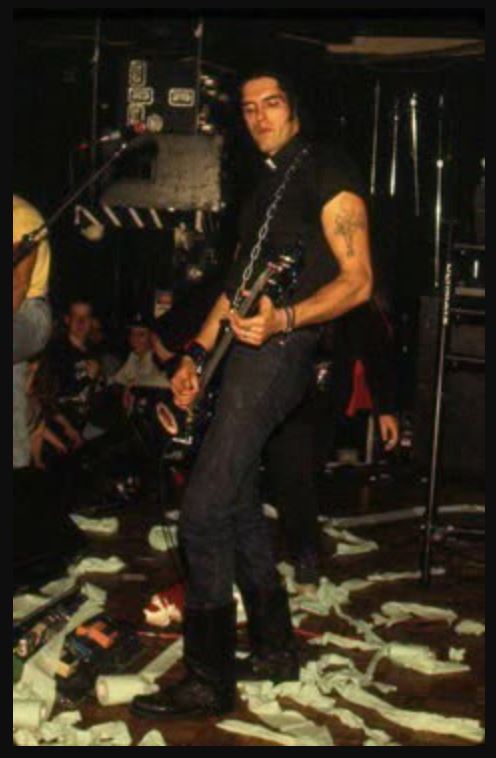 |
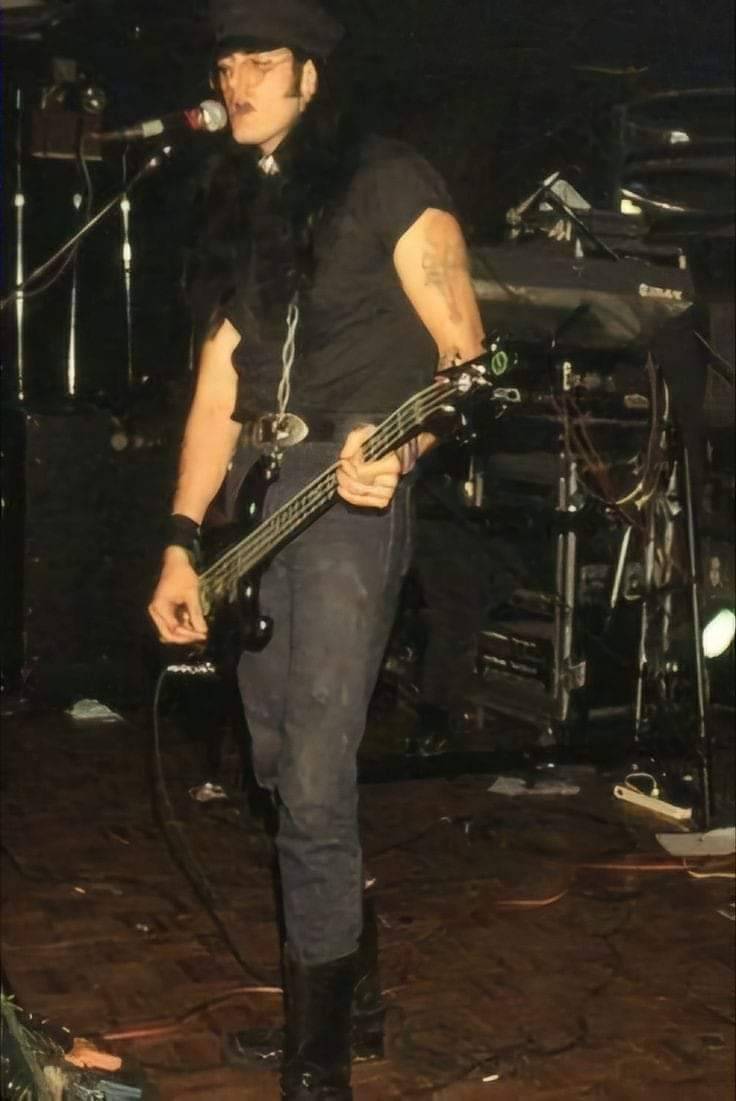
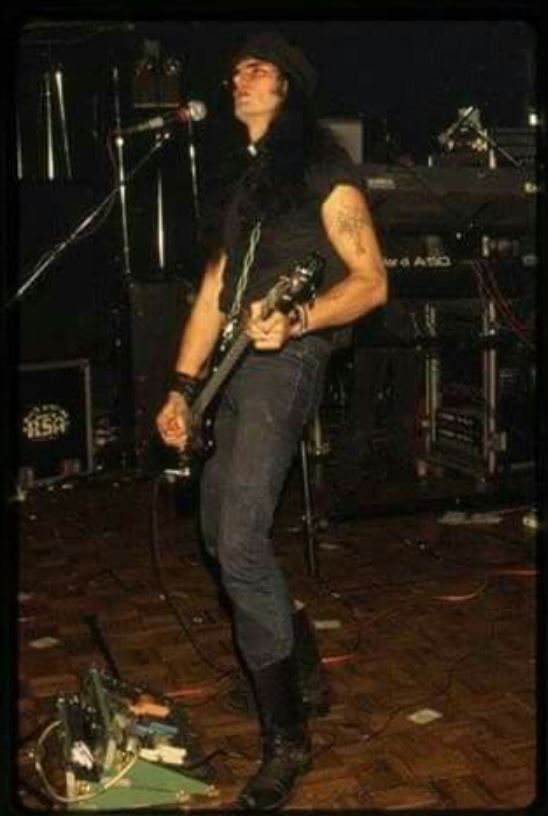
Lars does seem to be right if discussing Peter’s old rig versus his later rig. One of the above images came across the Circle Minus Facebook group. Based on the Alembic Spoiler, this performance was circa 1994 to possibly early-1995. The outer pedals are the DS-1 and likely a DD-3, but the middle pedal is certainly not a CH-1. At first, I thought it to be a CE-2 – there are some with a metallic blue paint that can look this dark and it does seem to change color in the photos, depending on the angle. But zooming in on the toilet paper photo, I may be seeing three staggered knobs and possibly yellow print: Depending on the date, this could be the rumored Blues Driver, which was released in 1995. It’s been so long, that I don’t recall where I read about the BD-2, but it is something I hadn’t forgotten. If I had to make an educated guess, I'd say it is a CE-2.
I had labeled this paragraph unverified and likely bunk for years, but have an update below. To add even more confusion, I ran across a repost from a 1996 interview in Livewire magazine where Peter verbalized the ubiquitous pedal configuration with the addition of a volume pedal (for feedback control?) between the CH-1 and DD-3. And according to a repost taken from the November 1998 Bass Player Magazine, Peter says he runs his bass "...through a series of Boss pedals: distortion, chorus, and delay for his normal heavy tone. When he wants a clean sound, a Marshall Y-box re-routes the signal through Boss tremolo and reverb pedals. 'For a clean song I get something that's a bit ambient, instead of just a straight clean. But when I switch over to distortion, it's like an avalanche of diarrhea,' he deadpans." I could not verify the existence of a Marshall-produced AB or ABY box, so am wondering if this could have been a Morley ABY since these were everywhere after their release in the early 1980s. Though listening to albums, I am not convinced that Peter had a tremolo throughout his career - I'm no expert, but it predominantly sounds like chorus to me. Plus, Peter preferred Boss pedals due to their rugged reliability and the TR-2 wasn't even available until 1997 (albiet, tremolo is one of the oldest effects), four years after Bloody Kisses. Consequently, I'm not sure if this is reliable information, Peter experimenting briefly, or possibly a red herring joke Peter later chuckled about - that would exlpain the so-called Marshall Y-box mixup. However...
 |
VIVA TV Nite Club (July 1997) The Auxilary Pedal Board? |
May 2025 Update (not verified; see Feb 2026 below): Circle Minus pointed me to a video I had not yet seen. I have verified it is from a July 1997 recording referenced as "Nite Club" in a European studio for television broadcast – performance footage was (re)broadcasted on VIVA 2 TV in 1999. There are a few camera pans that show a second pedal board, especially at 14:30. I appears that this pedal board is placed to the left of the main pedal board during the performance and is moved in front of the main board to make space for the interview. That additional board contains what appear to be three Boss pedals and something I am trying to identify. Likely possibilities for Boss pedals are the PN-2 (a tremolo released in 1990) and the RV-2 or RV-3 (reverbs released in 1987 and 1994). There’s been speculation of a Blues Driver (BD-2 released in 1995) in the rig - and in the poor photo of this board above, the third item in this auxilary chain does look to have two large knobs at the top. We should note that the TR-2 did come out in 1997, so it is a possibility - it also has two large knobs and would appear similar in color, especially in the dark, to the Blues Driver. I'm certainly not going to rule out a Boss BF-2 being in there. The first object on this board could be the ABY box or a volume pedal, but I’m still researching era-correct pedal images that might match. I suspect this second board was in use between 1996 and 1998, at the very least. Circle Minus and I speculate that in the later years, Peter (re)simplified his rig for touring, and only utilized the main pedal board ...at his feet, anyways.
Notable Times: 3:00; 10:05; 14:29; 15:20; 18:06.
Feb 2026 Update: I started thinking about this second signal path again. I currently run two, but was interested in the possibility of returning to a flanger due to this post. So looked at the above video again and started to wonder if this might be Kenny’s board pushed out of the way. It doesn’t really make sense given the cameraman never being in the area Kenny stands, but maybe it got pushed there so they could bring the chair and table on stage? If you check the extended video of that same performance at 35:40, are we seeing that “auxiliary board” at Kenny’s feet? I just don’t know because the video is so dark and low-res, plus the pans and logo do a hell of job of not showing the stage at their feet. There are shots where it appears there is no board for Kenny at all, so I’m stumped here.
Notable Times: 22:15; 34:20; 35:40 (Kenny’s?); 35:53; 41:07; 41:50.
Peter’s Clean Tone: 23:15 and 27:00.
Thoughts on reverb: if Peter used reverb (unless it was a joke, as he said it hid the band's mistakes), I would expect to see it in rackmount form since not seen at his feet because it would likely be always-on. I find it hard to believe that a reverb pedal was simply tossed into the rack and sitting atop a pile of cables or on one of the power amps. Granted, a pedal could be controlled off-stage, but that just doesn't seem to fit his style of having his rack within reach. I'm more inclined to believe that reverb was not something Peter included in his later tour rigs, and was likely left to the venue to address. Trying to replicate his album tone, reverb was certainly used.
SIGNAL ROUTING
Forum chatter speculates that Peter could have been running clean and distorted signals in stereo, each into separate power amps and cabs. Some even say three signals due to numerous photos of 810 cabs stacked behind him: one clean, one dirty, and one combination. I personally tried to run two signals into separate amps and cabinets, but did not like the results compared to combining them. The clean chain adds subtle definition when combined with the distortion chain into one signal, but the clean's highs seem overpowering when the two active signals are kept separate.
Many of Peter's rack preamps and amps have tape on them, with the legible ones saying "4X10" and "wedge" for his personal monitor. Andrew Marrapese wrote me in July 2021 that the EQ on the top Peavey 700 makes sense as a wedge/monitor amp since Peter would have to rely on that mids-heavy curve to hear himself over the rest of the band. Andrew also reminded me that Peter's EQ settings helped him to produce feedback with his monitor.
It appears that both of the MAX preamps in his rig had a cable inserted into the front inputs. Though they both have an effects return, the Bassist and the MAX do not have an auxiliary input on the rear panel (to note, the Peavey Tours do). I had initially thought that one may have been exclusively a backup. However, pics of Peter's Tour 700 heads clearly labeled "wedge" and one labeled "4X10" - I speculate the tape we see on the earlier MAX and Bassist preamps have the same designations. If Peter was running two signals, it appears it was only done so that he had his own monitor signal. This further solidifies my belief that he was not running separate clean and distortion signals in tandem. "Why did he have three cabinets, then?" Likely because he alluded that it wasn't uncommon for him to blow speakers - a tech could quickly swap or disconnect the speaker cable, then worry about a single speaker replacement before the next venue. The more I have dug into this, the more I believe Peter's "I'm a simpleton" remark. Many insist he was an avid tinkerer only because he said he added tweeters to his cabs in the early years, but I think Peter followed the K.I.S.S. philosophy beyond that.
March 2024 Update: I stumbled across a high-resolution pic taken in daylight showing both MAX units with an instrument cable plugged in to them. Finally, evidence that made the Tour "wedge" and "4X10" tapes make sense. So, there must have been some form of split occurring in the chain. I then went back to watch the Bizarre Festival 1999 footage, noting his Bassist preamps have tape in the same spots. Though it does appear that there is only one cable and it is going to the top unit - however, there is a cluster of what looks like wires (a splitter?) just beneath that. Experimenting with the DS-1 in 2024, I discovered that bypassing the pre gain by routing the pedal chain into the MAX's effects return reduced the amount of clipping to the distortion. The effects return on the MAX seems to enter after the critical EQ, whereas one of the returns on the Bassist enters before the EQ - so maybe that is why we see one Bassist Preamp with an empty input jack (because the other signal may be inputting at the back)? Like the MAX, the Tour 700's effects return also bypasses the all-important graphic EQ.
In the Starland Ballroom pic below: the top MAX has a 90* plug, while the bottom MAX has a straight plug. Gods of Metal: two straight plugs. Wacken: two straight plugs. Terminal 5: a straight plug into each Tour unit. During the May 2000 Howard Stern performance, both MAXs have a plug in them.
 |
 |
 |
 |
Starland Ballroom March 2007 |
Gods of Metal June 2007 |
Wacken August 2007 |
Terminal 5 June 2008 |
May 2025 Update: Circle Minus had done some reconnaissance back in the day and noticed that there was a second Furman and a third/backup MAX mounted on the back of Pete’s effects rack at one point. More importantly, he also believed that there was only one cable entering the front of one MAX during that show. It appeared to him that this primary MAX’s effects send was then routed to the second MAX’s effects return, and he believed this MAX was the signal used for the wedge and likely to boost wedge feedback. This is new info to me and I will be experimenting with the MAX's circuit routing possibilities.
Feb 2026 Update: I finally got around to experimenting with the effects loop a bit. There is a significant difference where the delay is placed, and placing it in the effects loop makes the initial note and echo sound more uniform than before the preamp. This sounds more like Peter’s delay, especially on Creepy Green Light, so I will start focusing more on this signal path in my own setup.
PETER'S FINAL RIG IN ONE PIC
The next photo was taken by Diana Gee (flicker) at Heavy MTL Festival in June 2008. A lot of cables, but no evident splitter. There is a straggler that looks like it is sneaking in from the pedal board area (green tape with white/black stripes) and it appears to go to the Auxiliary Input on what should then be a Tour 700. It also appears that the Effects Send of the lower tour has a plug in it. Certainly doesn’t look like anything else, like reverb or compression, is hidden in the rack.

Mimicking Pete's tones has been a hobby (read: obsession) of mine, and I have outlined my most current setup here.
If you have any interesting details, discoveries, or corrections, please email me.
Many thanks to those who have!

None More Negative
1962 - 2010
